
Wipott Jobs: The extension that never really worked
A tool I built to fix LinkedIn's broken job matching. It never worked properly—but the failure was more valuable than the solution.
Matias Rizzo
Feb 2nd, 2026

I didn't want to pay for LinkedIn Premium just to know if my profile matched a job posting. That was the trigger.
But the real problem was something else: my LinkedIn profile, like everyone else's, tells 30% of who I am. LinkedIn forces you to be a "superhero." There's no space for what you aspire to, what you're clear you don't want, the ideas that drive you, or the type of company where you know you'd thrive.
So I decided to build my own tool.
The approach
I took a year of conversations with ChatGPT - back and forth where I processed what I want, what I don't, how I think, what frustrates me - and turned it into a real bio. Not the polished version for recruiters, but the honest version no one publishes.
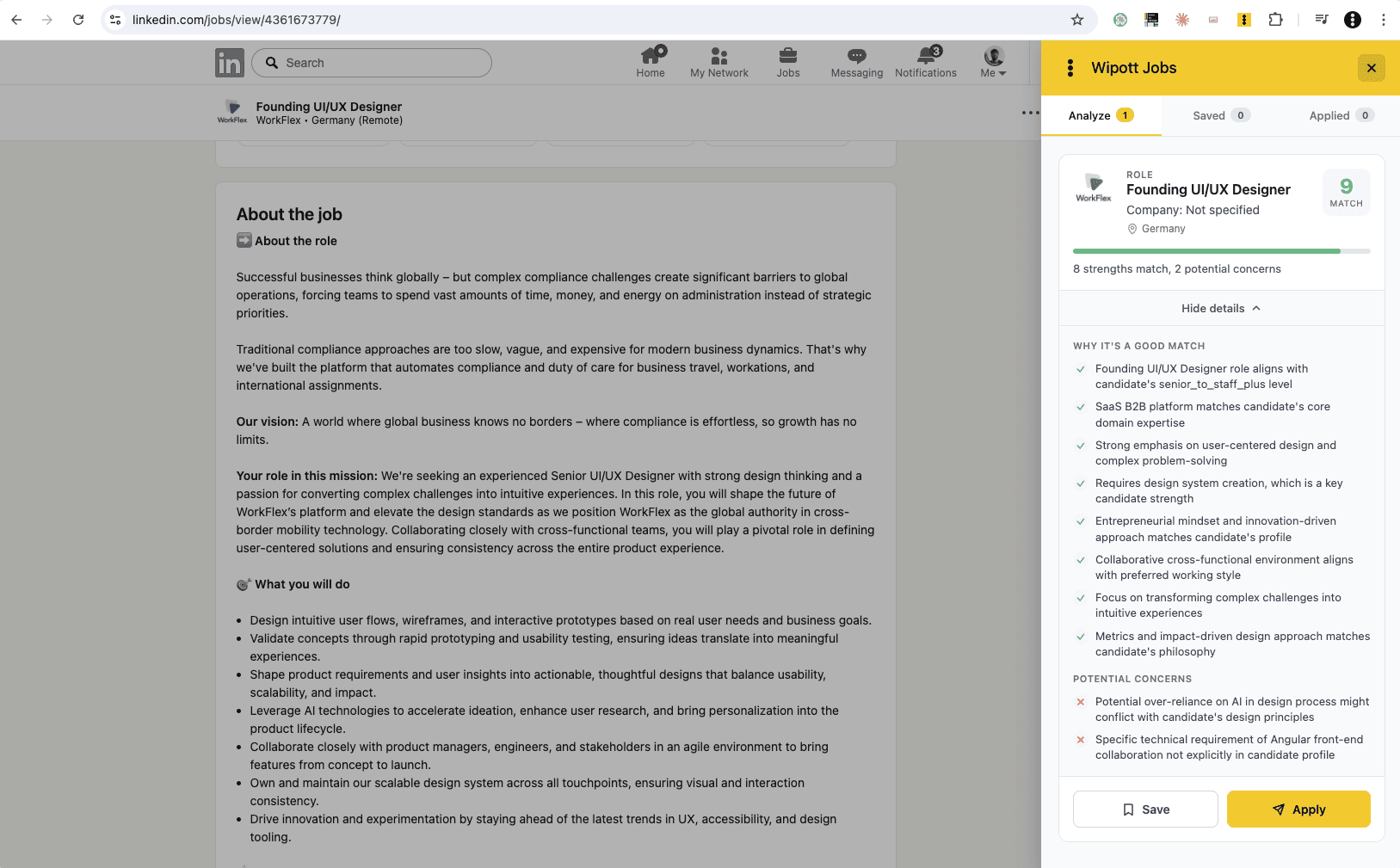
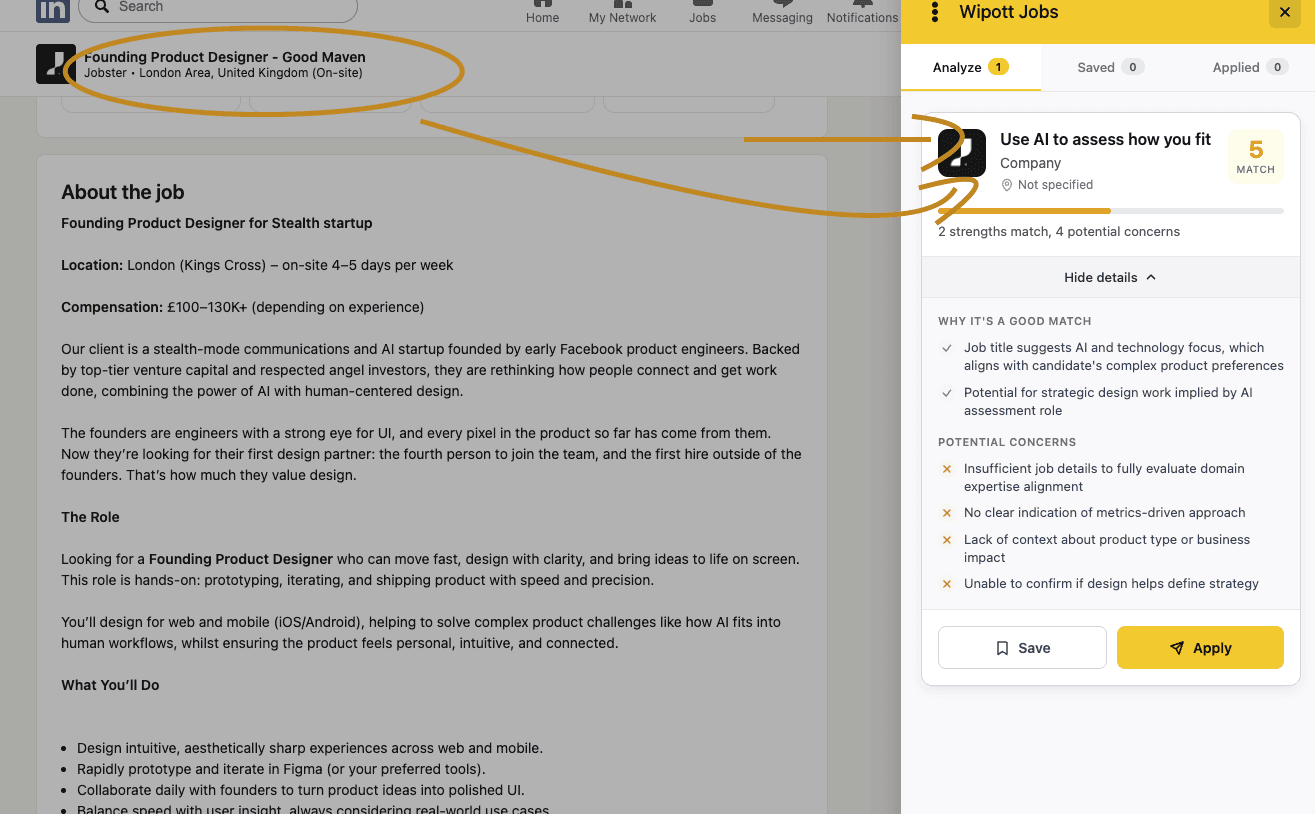
I structured that bio into JSON and built a Chrome extension called Wipott Jobs. The mechanics were simple: go to LinkedIn, look at a job posting, click once, and the extension returns:
Pros and Cons of the position
A Fit Score based on your real bio
A conclusion on whether it's a match or not
What actually happened
I barely used it.
Every time I reopened the extension after a week or two, something was broken. It wasn't reading the role correctly, or it missed the location, or it evaluated the wrong part of the page. I'd fix one thing and another would break.
It was a simple tool, vibe coded in Cursor. But "simple" didn't mean "stable." Eventually I stopped using it.
What I learned about vibe coding
This project taught me the real limits of working with LLMs for development:
Not everything you vibe code is perfect. The initial speed is real, but so is the fragility.
Building something in a single prompt - I still haven't pulled that off. It always requires many changes. Changes = Tokens. Tokens = Money.
You need to plan first and execute in separate tabs. If you don't, you fill the context window too fast and LLMs go crazy and do whatever they want.
Don't make them do too many tasks at once. You risk breaking many things at the same time. Then fixing it takes more prompts, more tokens, more money. A simple thing can turn into an entire day.
What I learned about LinkedIn (and the digital job market)
Beyond vibe coding, building this made me see the cracks in the system:
If I have to build this tool, there's an opportunity.
LinkedIn charges for something basic and doesn't even do it well.
The public profile isn't honest.
If I need a separate, deeper bio for an AI to evaluate my real fit, it means what's published is performance, not useful information. LinkedIn could have a section to upload a .md that's more AI-reader friendly - your real version, not your marketing version.
The filters are insufficient.
I look for companies with 50 employees max. That filter doesn't exist. LinkedIn doesn't understand that company size is a fundamental criterion for many people.
Everything is disconnected.
LinkedIn doesn't integrate well with the most-used HR platforms. That's why most companies have their hiring flows outside LinkedIn. And when you're job hunting, you end up with everything fragmented: LinkedIn + Emails + Greenhouse + the rest. Each application in a different place, each response somewhere else, no unified tracking.
The vision: what would do this right
If someone wants to solve this properly, the value isn't in the score. It's in automating the entire loop:
Job scraping
Fit evaluation (Score + Pros/Cons)
Application tracking (Applied / Not Applied)
Email integration that reads responses and updates status automatically
A unified dashboard for your job search
I understand that unemployment usually lasts "a short time," so building such a structure might not seem profitable. But there's a model where it works.
Companies like onTop in Latin America already cover the most important part for freelancers: payments and administrative services. This job search module could be their perfect client consolidation play:
When you have work, you manage your payments there
When you don't have work, you manage your job search there
You never stop paying the membership because it covers the entire cycle
Closing
Wipott Jobs started as a tool to avoid paying for LinkedIn Premium. It ended up being a crash course in the limits of vibe coding and everything that's broken in how we search for jobs.
I don't use the extension anymore. But it taught me more about working with LLMs - and about product opportunities - than many projects I actually finished.
Matias Rizzo
Feb 2nd, 2026
Back to Homepage